
Receipt and bill capture for practices on QuickBooks Online
You check each one, and Otto publishes it to the client's QuickBooks Online company as a bill or supplier credit, with the original attached. Capture publishes purchases to QuickBooks Online, not sales invoices. Nothing reaches QuickBooks until someone in your practice has reviewed it.
Built by a practice, for practices
We run an accounting practice. We tried a lot of receipt capture tools, and none had the mix of features and pricing that worked for our clients. The small rough edges added up too, using them day in, day out.
So we built Otto Capture around the jobs that took our time. Clients send documents without creating an account. And Otto reads every line and suggests a category from that client's own history.
What Otto does for your QuickBooks clients
Every line, not just the total
Otto reads the supplier, the dates, the totals and every line item on each document, as standard. A receipt with five different purchases on it reaches QuickBooks as a bill with five lines, each with its own category and VAT code, where some tools charge extra for line items.
Categories that learn each client's suppliers
Otto suggests a category for each line from how you've coded that client's bills from the same supplier. He learns one client at a time, from the bills you publish through Capture, including anything you changed in review, so his suggestions draw on more of that client's history as you go. For a supplier the client hasn't used before, he suggests a category from the document alone, and you decide.
Clients send documents without an account
Each client has their own email address, submission page and WhatsApp invite link, and you choose which to give them. Whoever holds the receipts just sends them. Nobody creates an account or installs anything, and you don't register anyone in advance.
Missing receipts isn't available for QuickBooks Online clients yet. If you'd like it for them, tell us, because it helps us decide what to build next.
How it works
- Your client sends a receipt or bill by email, through their submission page, or on WhatsApp.
- Otto reads it, matches the supplier to one of the client's QuickBooks suppliers, and suggests a category and VAT code for each line.
- Someone in your practice checks it and changes anything that needs it.
- You click Publish, and Otto creates the bill or supplier credit in the client's company, with the original document attached.
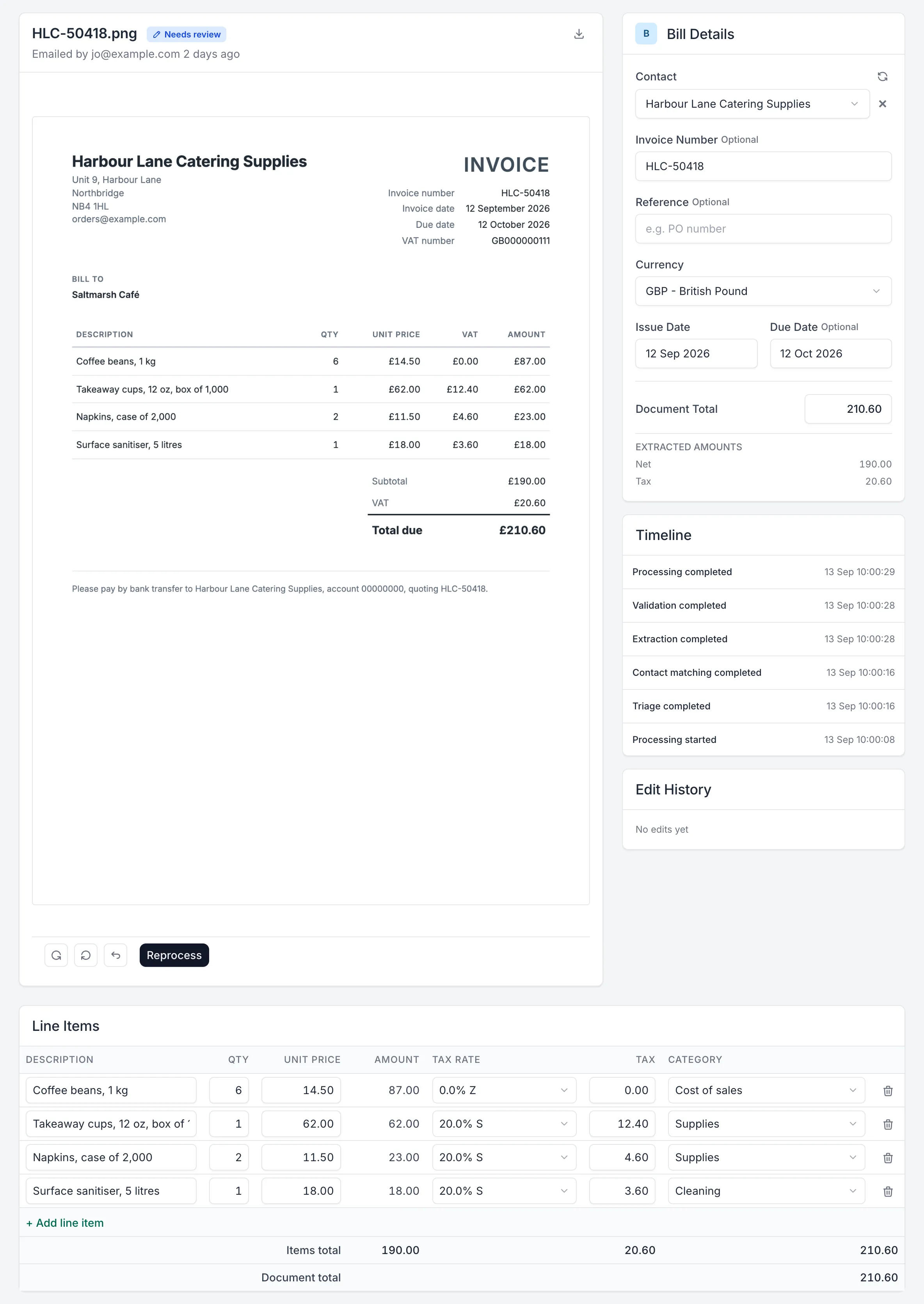
What lands in QuickBooks is what you checked
A bill in the client's books should match the document it came from.
- VAT read and checked line by line. Otto reads the VAT code and amount on each line, and checks the lines add up to the document's net, VAT and total. In review, a line whose VAT differs from its rate shows the rate's figure beside it, and a bill whose lines don't match its total is flagged before you publish. QuickBooks then records the VAT you approved.
- Foreign currency at the client's own rates. With multi-currency on, a bill publishes in its own currency at the rate in the company's own exchange rate table, so it's valued the way the client's books value it. You can also convert a document to the amount that cleared the bank.
Connecting a client's company
You connect each client's QuickBooks Online company to Capture on its own, so you can start with one client and add the rest when you're ready. Capture brings across that company's suppliers, chart of accounts, VAT codes and classes, so Otto's suggestions use that client's own lists from the first document.
Capture uses the connection to create suppliers, bills and supplier credits, and to attach the original documents. It adds a currency to the company only when you choose to during review. The details are in Otto Capture's QuickBooks Online guide.
What it costs
Otto Capture is priced per client, per month, on three tiers. A client with no published documents in a month costs nothing. Each client sits on whichever tier is cheapest for what it published that month, and reaching a tier's allowance doesn't tip it into a bigger bill.
Small
£9per client, per month, excl. VAT
- Included published documents
- Up to 50
- Each extra document
- 18p
Medium
£15per client, per month, excl. VAT
- Included published documents
- Up to 125
- Each extra document
- 12p
Large
£29per client, per month, excl. VAT
- Included published documents
- Up to 350
- Each extra document
- 8p
- No documents, no charge.
- Always the cheapest tier.
Estimate your monthly cost
Tell us how your clients split across the tiers. A best guess is enough, because most clients cost exactly their tier’s price.
About £156
per month, excluding VAT
£36 saved4 clients with nothing published cost £04 clients at £0
Some clients busier than their range? There’s no jump to a bigger bill. Extra documents are charged at the tier’s per-document rate until the next tier works out cheaper, and the client then moves up automatically.
Full pricing is on the Otto Capture page.
Try it on as many QuickBooks Online clients as you like
The free 30-day trial has no limit on clients or documents, so connect as many client companies as you like. We'd suggest putting Otto through his paces: include the clients whose paperwork takes longest each month, and send in a few weeks of their receipts and bills. Review them with every line already read and a category suggested, then publish them to QuickBooks.
Otto Capture is available to UK accounting and bookkeeping practices.
Your clients can be on any mix of Xero, FreeAgent, and QuickBooks Online. On QuickBooks Online, Otto publishes purchases.